An Easy Guide to Trademark Class 27: Carpets, Rugs, and Mats
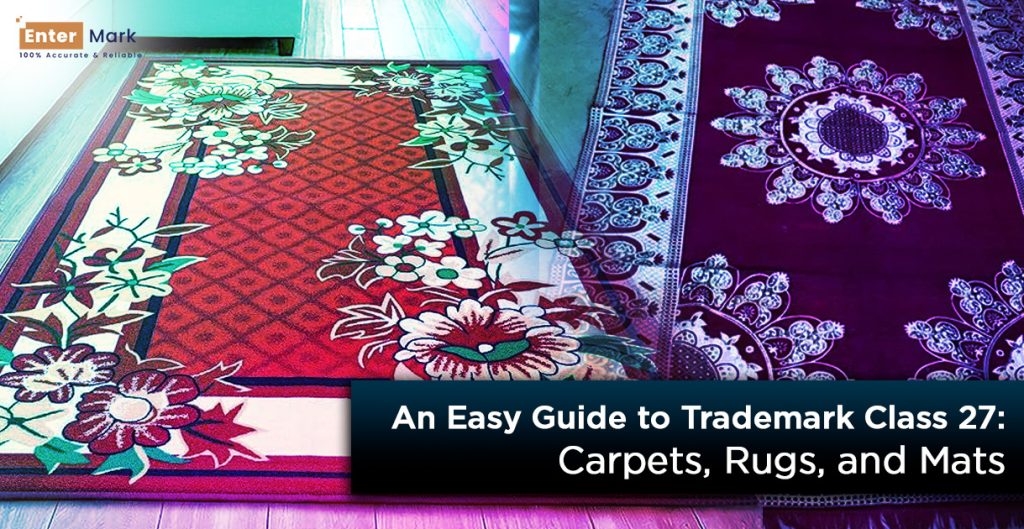

Trademark Class 27 consists of carpets, rugs, mats, wall hangings, artificial turfs, etc. It is a very narrow class by nature and does not have many products, making it easier to understand precisely which products are included.
This class mainly covers materials to be added to constructed walls, floors, ceilings, etc. Flooring, tiles, etc., are excluded from the scope of Trademark Class 27 because they are considered part of the floor, hence the construction.
These add-ons may be decorations, such as carpets, wall hangings, etc. or functional, such as turfs, wallpapers, etc. Textile covers and wall hangings have been excluded from this particular class.
Information of Goods Under Trademark Class 27
Below is a detailed list of goods covered under Trademark Class 27:
| Products List | Products List |
|---|---|
| Artificial lawns | Bath mats |
| Artificial turf | Bathroom floor mats |
| Artificial grass | Beach mats |
| Area mats | Carpets |
| Area carpets | Car mats |
| Anti-slip carpets | Car rugs |
| Anti-slip rugs | Carpet tiles |
| Automobile carpets | Coverings (for floors) |
| Doormats | Carpet underlays |
| Desk mats | Floor coverings |
| Decorative wall hangings | Floor mats |
| Fur rugs | Gym mats |
| Foam mats | Handmade carpets |
| Fabric coverings for walls | Handmade rugs |
| Hard coverings for floors | Imitation turf |
| Insulating wallpaper | Linoleum |
| Imitation fur mats | Linoleum tiles |
| Linoleum floor covering | Mats |
| Mats for vehicles | Non-slip mats |
| Matting | Non-slip desk mats |
| Non-textile wall hangings | Padded floor covering |
| Pet mats | Rubber mats |
| Paper mats | Reed mats |
| Prayer rugs | Rugs |
| Plastic wallpaper | Straw mats |
| Plastic floor covering | Silicone mats |
| Plastic wall hangings | Tatami mats |
| Tapestry | Underlays |
| Tiles (linoleum) | Vinyl floor covering |
| Textile wall covering | Vehicle mats |
| Turf | Vinyl tiles |
| Vinyl wallpapers | Wallpaper |
| Wooden mats | Wrestling mats |
| Wall hangings | Yoga mats |
| Wall coverings |
Read more: The Basics of Trademark Class 26: Lace and Embroidery
Some Famous Class 27 Trademarks
Some of the most famous Class 27 trademarks are:
- Shaw Floors: Shaw is a global brand with an Indian business unit. It is renowned for offering a wide range of carpeting solutions.
- FLOR: This new-age brand focuses on innovative, aesthetic designs that are in demand in the market. Flor is known for its aesthetic carpet tiles.
- Tarkett: A leading company in the global flooring industry, Tarkett provides a wide range of flooring solutions, including high-quality carpeting, durable linoleum, versatile vinyl, and stylish laminate flooring products.
- Dresso: Known for its sustainability, it offers a wide range of carpet and carpet tiles companies.
- Godrej Interio: Godrej Interio is part of the Godrej group and specialises in manufacturing furniture and appliances. It is also Godrej’s home decor brand, offering many options, including carpets, rugs, and more.
- Jaipur Rugs: This Indian carpet company is known for its handmade rug services, which involve traditional Indian designs and offer many options, including rugs and carpets.
Goods NOT Included in Trademark Class 27
Keeping yourself updated on the types of products listed in Trademark Class 27 is essential if your item belongs to this category and you plan to acquire a trademark. However, it’s crucial to understand the items that do not belong to this class to prevent any confusion.
The goods that are not a part of this class are:
Floor and Floorings
Floors and flooring materials such as tiles, wooden boards, planks, marble flooring, etc., are not a part of Trademark Class 27. Metallic flooring and tiles belong to Class 6, whereas other flooring made of different materials, including wood, is placed in Class 19.
Textile Wall Hangings
Household textile items, including bed sheets, table covers, etc., are included in Class 24. Textile wall hangings are also excluded from Class 27. However, textile door mats, carpets, and rugs are included in Class 27.
Heated Carpets
Electrically heated carpets are placed in Class 11 (Environmental Control Apparatus).
Certain Mats
Certain mats, such as mats for infant playpens and rubber mats, are not considered under Trademark Class 27.
Read more: Trademark Class 25: Clothing, Footwear, and Headgear
Corresponding Classes of Trademark Class 27
Corresponding or related classes are the classes that most closely resemble the concerned class, which in this case is Trademark Class 27. Corresponding classes contain goods that are related to the goods in question. A good or service can be trademarked under multiple classes; the corresponding classes are usually chosen.
Given below are the corresponding classes of Trademark Class 27:
· Class 19 (Building Materials)
The products in this category are related to building and construction and are manufactured using various materials. Class 19 includes items such as tiles, wooden flooring, veneers, and non-metallic building materials like non-metal rigid pipes.
· Class 20 (Furniture, Mirrors, and Frames)
Class 20 items include furniture, picture frames, and goods made of wood, cork, ivory, etc. These items are used for home decoration and may be associated with wall hangings and floor coverings, which fall under Class 27.
· Class 24 (Textile and Textile Goods)
This category includes fabrics and fabric products, such as bed linens, blankets, and tablecloths. These products may be associated with the products in Category 27.
Benefits of Trademarking Your Goods and Services
There are many benefits to trademarking. It fosters creativity in the world and ensures that the fruits of your labours are protected for your consumption. Trademarks make you the exclusive owner of your branding elements, colours, designs, packaging, etc., which makes replicating your product’s positioning impossible for your competitors. The World Intellectual Property Organisation has made strides in the right direction towards inventing a new world with more respect and protection for intellectual property.
Given below are the main benefits of trademarking your goods and services:
- Brand Identity: Brand identity refers to the positioning of your product or service in the customer’s mind. It is how they perceive your product. Aesthetic and design choices and other packaging, product, and pricing decisions decide the brand identity. Trademarking your brand’s intellectual property ensures that your brand identity is unique and your product cannot be copied. Protecting your brand identity is essential to protect your customer base and prevent replication of your product.
- Legal Protection: Acquiring a trademark registration for your product or brand provides the crucial benefit of having the exclusive legal right to use the trademarked intellectual property. This means that competitors are prohibited from using the trademarked intellectual property to imitate or copy your product or service, thus preventing situations where competitors attempt to appropriate your success and reputation. Accused parties in trademark infringement lawsuits may face jail time, fines, or both. The extent of legal protection and the penalties involved vary from one class to another.
- Licensing Opportunities: It is not permissible for anyone to utilise your trademarked intellectual property without obtaining legal authorization. Nevertheless, with appropriate legal consent from the trademark owner, others can utilise the trademarked intellectual property. As a trademark owner, you can permit interested parties to use your trademark in exchange for compensation. This process is referred to as trademark licensing. Trademark licensing represents an effective method for increasing your earnings and creating a new revenue stream.
- Marketing Tool: Trademarks have historically been significant elements of marketing campaigns. From the shape of the iconic Coca-Cola bottle to the famous bitten Apple logo, trademarks are a core component of marketing efforts. When harnessed correctly, trademarks can be remembered through the ages. It is essential to protect such iconic elements lest their significance and market presence be destroyed by plagiarism. Coupled with stiff competition and an abundance of market players, it is even more significant to have good marketing. Trademarks are a core unit of a product, be it through design, packaging, colours, etc. These attributes are crucial in making a creative marketing campaign.
Conclusion
Observing the above, it is evident that trademarking your product or service offers numerous advantages. It enables unhindered expansion without rival interference and guarantees that consumers can access your distinctive offering. Absent trademarks, all market participants would attempt to imitate the successful strategies of others, resulting in replication. Consequently, trademarks encourage innovation.
Trademark Class 27 encompasses various ornamental items, such as rugs and wall decorations. Sure, rugs are costly and can be crafted from rare, pristine materials, requiring extensive labour from skilled artisans. Manufacturers of such rugs should secure trademarks for their patterns, designs, and other elements to compete with industrial producers effectively. Trademarking establishes your official legal ownership of the trademarked property and encourages others to develop their unique concepts, thereby fostering the creation of new inventions globally.
Get expert support for conducting a trademark search and experience the benefit of trademark registration and trademark monitoring.
Frequently Asked Question
What is Trademark Class 27?
Class 27 trademarks cover carpets, rugs, mats, linoleum, and other materials used to cover existing floors and non-textile wall hangings. This class primarily includes products meant to be added as furnishings to previously constructed floors and walls.
Are tiles a part of Trademark Class 27?
Tiles, wooden flooring, and similar items do not fall under Class 27. Class 27 specifically pertains to supplementary goods applied to floors and walls post-construction. Tiles and flooring are considered part of the construction phase.
Is artificial grass a part of Trademark Class 27?
Yes, artificial grass turfs are a part of Class 27 since they are also a type of floor covering. Other types of turf are also a part of this class for the same reason.
What is NCL?
The NCL is a classification system for goods and services, facilitating obtaining trademarks. Applicants must apply for trademarks within the specific class corresponding to their product or service.
What is a trademark?
A trademark is a certificate that grants you the exclusive right to use a particular piece of intellectual property, such as a colour, word, symbol, phrase, slogan, etc. Only the trademark holder can use that intellectual property legally.
What is the punishment for trademark rights violations?
In India, proven trademark infringement cases can make the accuser liable to a fine of not less than Rs. 50,000, which may extend to Rs. 2,00,000. In more severe cases, jail time of not less than six months can also be given.
How can I trademark my goods?
To trademark your goods or services in India, a duly filled application has to be made to the Indian Trademarks Registry. The applicant has to ensure that the proposed trademark doesn’t already exist. After carefully considering the application, the Indian Trademarks Registry may grant the certificate.
How long is a trademark valid?
After issuing the certificate, the trademark remains valid for ten years. The trademark must be renewed at the end of every ten years.
Which trademark class is a carpet?
A carpet falls into Trademark Class 27, encompassing floor coverings, wall coverings and hangings, and ceiling decorations and hangings.
Read more Blogs: The Basics of Trademark Class 26