All about Trademark Class 7: Machines and Tools
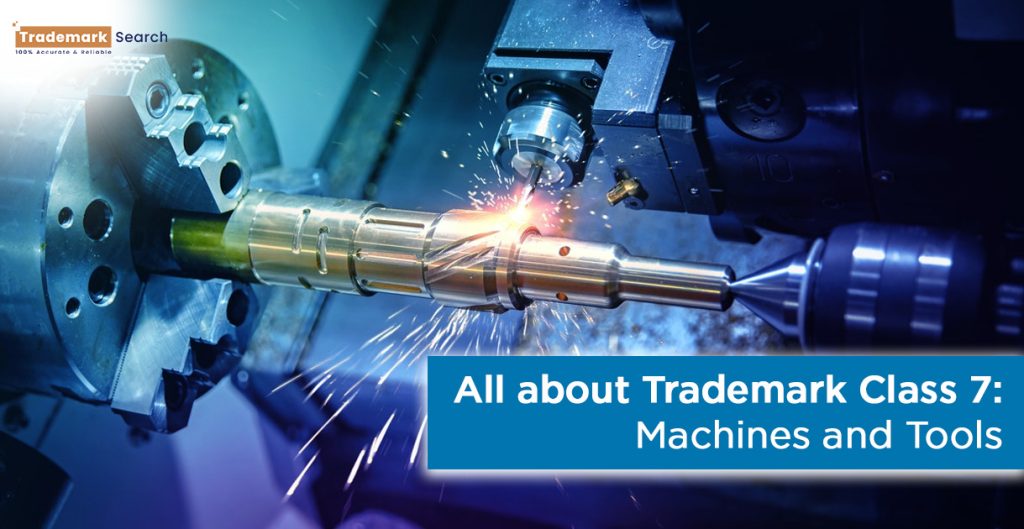

Trademark Class 7 consists of machines and machinery tools. It also includes motors and engines (except land vehicles) and power-operated tools. Agricultural implements (other than land vehicles and hand-operated implements) are also included in this class.
It also included incubators for eggs, vending machines, etc. Essentially, Trademark Class 7 covers all sorts of machinery and power-operated tools, along with all the components that are part of such machines and tools, for example- blades of fans.
Categories Covered under Trademark Class 7
These are the broad categories covered under Trademark Class 7:
Machinery:
Trademark Class 7 includes all kinds of machines and machinery apparatus. This includes industrial machines and manufacturing equipment such as bottle-filling machines, conveyor belts, etc. Motors and fans are also part of Trademark Class 7.
Machinery used in vehicles, such as carburetters, is also included in this category, except for motor and engine use for land vehicles. Some household consumer electronics, such as washing machines, dishwashers, vacuum cleaners, etc., are also part of the definition of machines and machinery equipment.
Power-Operated Tools:
This definition includes handheld machine tools, such as drilling machines, nail guns, electric screwdrivers, etc. Hand-operated hand-held tools are excluded, and only power tools are included. Electric pumps, cutters, shaping machines, hydraulic presses, etc., are also included in this category. Guns (explosive tools) are also in Trademark Class 7.
Motors and Engines:
Internal combustion engines for industrial machines, motors and parts of motors for industrial use and hydraulic engines for industrial use also form part of Class 7. Any motor or engine to be used in land vehicles is excluded as they are included in Class 12.
Engine mounts, brackets, cooling systems, etc., are also in this category. Any item used in or as machinery equipment in motors or engines is classified under Trademark Class 7.
Agricultural Implements:
Tractors, combine harvesters, and other agricultural machines are classified under Class 7. This also includes power tools used in agriculture, such as drillers, seed distributors, electric irrigation systems, water pumps, etc. Hand tools such as shovels and rakes are excluded as they form part of Class 8.
Read more: The Basics of Trademark Class 8: Hand Tools and Implements
Types of Goods Under Trademark Class 7
There are several kinds of machinery and tools included in Trademark Class 7. A detailed classification of the kinds of products included in this class is given below:
Machines
| Goods List | Goods List |
|---|---|
| 3D Printers | Aero condensers |
| Air condensers | Bending machines |
| Bitumen making machines | Bottle-filling machines |
| Bottle-sealing machines | Crushing machines |
| Die stamping machines | Dishwashers |
| Washing machines | Vacuum cleaners |
| Dyeing machines | Filtering machines |
| Food processors | Construction machines |
| Mining machines | Industrial robots |
| Textile machines | Printing machines |
| Packaging machines | Food processing machines |
| Woodworking machines | Metalworking machines |
| Paper machines | Plastic processing machines |
| Glass working machines | Pharmaceutical machines |
| Semiconductor manufacturing machines | Cleaning machines (industrial) |
| Welding machines | Foundry machines |
| Asphalt laying machines | Concrete mixing machines |
| Ceramic manufacturing machines |
Machine Tools
| Goods List | Goods List |
|---|---|
| Drilling machines | Milling machines |
| Lathes | Grinding machines |
| Cutting machines | Boring machines |
| Tapping machines | Broaching machines |
| Flattening machines | Shaping machines |
| Honing machines | Gear cutting machines |
| Punching machines | Presses |
| Shearing machines (for cattle) | Saws (machine tools) |
| Tool holders (machine tools) | Machine tool parts |
| Machine tool accessories | Die-cutting machines |
| Power Tools | Electric drills |
| Electric screwdrivers | Angle grinders |
| Circular saws | Jigsaws |
| Planers (Electric) | Sanders (Electric) |
| Polishers (power tools) | Routers (power tools) |
| Impact wrenches | Heat guns |
| Rotary hammers | Demolition hammers |
| Nail guns | Staple guns |
| Power tool parts | Power tool accessories |
| Cordless power tools | Electric saws |
| Electric sanders |
Motors and Engines
| Goods List | Goods List |
|---|---|
| Internal combustion engines (except for land vehicles) | Camshafts for vehicle engines |
| Driving chains | Motors |
| Electric motors (AC, DC, brushless) | Hydraulic motors |
| Pneumatic motors | Stepper motors |
| Linear motors | Gear motors |
| Inverter drives for motors | Motor controllers |
| Generators (Electric) | Compressors (air) |
| Pumps (hydraulic, water) | Fans (Industrial) |
| Blowers (Industrial) | Wind turbines |
| Solar panels | Gears and gearboxes |
| Bearings | Engine mounts |
| Propulsion mechanisms | Torque converters (for other than land vehicles) |
Agricultural Implements
| Goods List | Goods List |
|---|---|
| Combine harvesters | Electric irrigation systems |
| Automatic seeders | Tractors |
| Electric piping solutions | Electric rakes |
| Powered ploughs | Milking machines |
| Harvesting systems | Greenhouse equipment |
Items NOT Included in Trademark Class 7
As the definition of machines and machinery tools is quite broad, it is essential to remember what falls under Trademark Class 7. Certain items may seem like they should be included in Class 7 but are not.
Given below is a list of products and product categories that are NOT part of Class 7:
- Hand Tools and Implements:
All kinds of hand-operated tools are excluded from the definition of machines for Trademark Class 7. Tools like shovels, pitchforks, rakes, manual sprayers, etc., are included in Class 8 and not 7. Class 7 emphasises power operation or electric functioning.
- Motors and Engines for Land Vehicles:
Motors, engines, transmission components, and other components intended for use in land vehicles are excluded from the purview of Class 7. They belong to Class 8 instead. Similarly, remote control vehicles, except toys, are also part of Class 12 instead of Class 7.
- Robots:
Certain robots, with or without artificial intelligence, are excluded from Trademark Class 7. Robotic cars belong to Class 12 (Vehicles), whereas surgical robots belong to Class 10 (Medical Equipment). Similarly, teaching robots, surveillance robots, etc., are excluded from Class 7. Only industrial robots are classified under Class 7 (Machines and Tools).
- Special Machines:
Specific machines are excluded from Class 7. These include Automatic Teller Machines (ATMs), refrigerating apparatus, and respirators for artificial respiration.
Read Our Article: Trademark Class 6: Metal Goods and Hardware Items
Corresponding Classes of Trademark Class 7
Corresponding or related classes are the classes in which related goods or goods that can be mistaken for belonging to Class 7 fall. Certain products may also fall under multiple classes and be registered as such. Corresponding classes are the classes most homogenous in nature to a particular class, which, in this case, is Class 7.
Given below is a list of classes that are most closely related to Trademark Class 7:
Class 6 (Metal Goods):
Metal pipes, safes, metal hardware and metallic building materials are included in Class 6. Nuts, bolts, screws and other small metallic fittings are included in Class 6. These items are also used in machine equipment; hence, they can be confused for being in Trademark Class 7.
Class 8 (Hand Tools and Implements):
Class 8 includes hand-operated, non-powered tools, such as implements for agriculture, artists, sculpture, etc., household cutlery, and medical hand-held tools, such as surgical blades and scalpels.
Class 9 (Electronics and Computers):
Class 9 covers electronic equipment used in various domains. This includes personal computers, keyboards, audio equipment, and other peripherals. Navigation equipment and scientific apparatus operated electronically are also part of Class 9. Computer software and mobile applications are also included in Class 9.
Class 11 (Environmental Control Apparatus):
Class 11 includes air conditioners, heating apparatus, radiators, lighting apparatus, sanitation fittings such as bidets and humidifiers, electronic cooking appliances, lamps, air purifiers, and more.
Class 12 (Vehicles):
Motors and engines for land vehicles and land vehicles themselves are included in Trademark Class 7. Bicycles, wheelchairs, and vehicle upholstery are some sub-components included in this class. As are aircraft and helicopters, water navigation vehicles such as boats and yachts are also part of Class 12.
Some Famous Class 7 Trademarks
Below is a list of Class 7 trademarks that have gained popularity. These trademarks demonstrate how getting a trademark for your intellectual property can help you protect your identity and retain your customer base.
- Siemens: A prominent name in industrial machines, their name is famous for their elevators and lifts that can be seen everywhere.
2. ABB: One of the leading names in automation and robotics.
3. Bobcat: Bobcat is famous for their heavy-duty construction machines and equipment.
4. Doosan: Their excavators and wheel loaders are a site at almost every construction site.
5. Bosch: Also famous for their household appliances, Bosch is also a big name in industrial machinery.
Process of Getting Registered under Trademark Class 7
In India, the process of getting a trademark registration is pretty uncomplicated. However, there are many legal requirements and approvals, and you may need to seek help from a third party to secure a trademark for your product or service.
The process of getting registered under Trademark Class 7 has been outlined below:
Trademark Search:
The first step is to search comprehensively through the list of existing trademarks and ensure that your proposed trademark does not exist. The Indian Trademark Registry maintains a comprehensive list of all trademarks that must be checked to ensure that a similar trademark does not exist.
Application:
A thorough application must be made to the Indian Trademark Registry that includes the nature of the trademark. It should consist of all the details representing the trademark, an appropriately selected class, and the description of the product or service it will be affixed to.
Another essential detail to include is the date of first use of the trademark (sale/service rendered) or the proposed first date. It must follow all the provisions of the Trademarks Act, 1999, and Trademarks Rules, 2017.
Publication in Trademark Journal:
If the application is accepted, it is published in the Trademark Journal. Usually, four months are allowed after this as an objection period to invite objections to your proposed trademark.
Issue of Certificate:
Suppose no objections to the trademark exist, or the objection is settled in the applicant’s favour. In that case, the registrar issues the trademark certificate, which officially signals the trademark’s inclusion in the Indian Trademark Registry. The trademark remains valid for ten years, after which it has to be renewed every ten years.
Benefits of Getting Registered under Trademark Class 7
There are many benefits to getting registered in India’s trademark registry. Some of them are mentioned below:
- Brand Identity:
Registering a trademark means you have exclusive rights to the trademark. It is an intellectual property that you own. A trademark can be crucial to creating and maintaining a distinguished brand identity. It helps customers identify your product from many available alternatives, supporting brand loyalty.
- Legal Protection:
As you have exclusive rights over your trademark and its use, any competitor who tries to replicate your identity by copying it becomes liable for legal action and may land in heaps of legal trouble. Your trademark is the best tool to protect against infringement.
- Market Positioning:
A trademark helps you differentiate your brand. When used with clever marketing, a trademark becomes a brilliant tool to ensure that consumers remember your product for a long time and continue buying it.
- Marketing Efforts:
Trademarks serve as highly creative elements for establishing successful marketing campaigns. Many companies have used trademarked works or slogans to distinguish their marketing efforts.
Conclusion
Trademark Class 7 of the Nice Classification comprises machinery, machine tools, and equipment. It does not include hand-operated hand tools. To explore the space of trademark search API and experience the power of AI revolution in the world of trademark, To get expert assistance in trademark monitoring and trademark Objection, visit Trademark Search.
Frequently Asked Question
What is Trademark Class 7?
According to the Nice Classification (NCL), goods and services are divided into 45 classes according to their nature and purpose for trademarking purposes. Trademark Class 7 consists of machines, machinery equipment, and power tools.
Which goods are included in Class 7?
Class 7 consists of machines, power tools, machinery equipment, motors and engines (except for land vehicles), and agricultural implements operated through electricity or engines.
Are vehicles a part of Trademark Class 7?
No, vehicles are not a part of Class 7. They are included in Trademark Class 12. However, engines for non-land vehicles such as aircraft and ships are included in Class 7.
Are tools included in Trademark Class 7?
Power tools and electric tools are included in Class 7. Such tools include power drills, nail guns, electric sprayers, etc. However, non-power hand-operated tools are not part of Class 7 and have their class, Class 8.
How long is a Class 7 trademark valid?
Trademark validity does not depend on the class of the product or service. All trademarks are initially valid for ten years and should be renewed every ten years.
Can I get my product registered in multiple classes?
Yes, if your products fall under multiple classes according to their nature, they can be registered under various courses. An example would be ITC, which sells different products that belong to different trademark classes under its ‘ITC’ trademark.
How many trademark classes are there?
According to the latest edition of the Nice Classification (NCL) released by WIPO (World Intellectual Property Organisation), there are 45 trademark classes. Classes 1 to 34 cover goods, whereas classes 35 to 45 cover services.
What are some exceptions to Trademark Class 7?
Special machines such as Automatic Teller Machines (ATMs) and respiratory equipment are exceptions. Even though they are machines, they belong to different classes.
Are consumer electronics part of Trademark Class 7?
No, consumer electronics are generally not part of Trademark Class 7. However, specific household appliances, such as washing machines, are.
How can I ensure my product falls under Class 7?
If your product is a machine intended for commercial or industrial use, it most likely falls under Class 7.
Read Our Article: Trademark Class 5: Pharmaceuticals